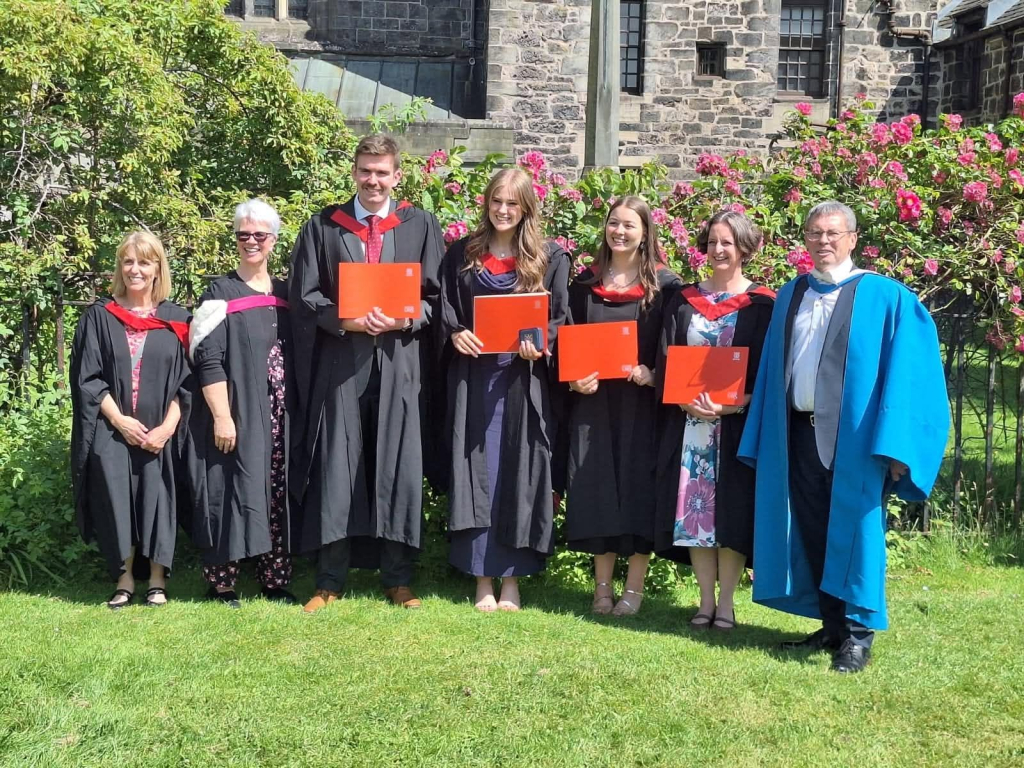


Introduction to the Programme
The BD (Hons) in Theology with Pastoral Studies programme is our core programme training for ministry and chaplaincy. The programme covers the foundations in biblical studies, foundations in doctrine and church history, as well as a broad range of practical / pastoral theology. The programme, however, is designed for much more than traditional church ministry, helping students to discover their call, nourish their faith, and reach their potential.
We envisage students to be passionate about learning about God, deepening their own faith, and feel called to help others experience God’s presence in their life. The BD programme helps students to become well rounded practitioners for whatever ministry they are called to, whether that’s chaplaincy in healthcare, hospices, or prisons; church and caring ministries; or broader areas of ministry through school teaching or third sector vocations.
Students study at SBC for many different reasons from across many different denominations and backgrounds. We do, however, partner with the Baptist Union of Scotland to provide training for accredited ministry. For those studying for Baptist ministry, the key competences required by the Baptist Union of Scotland are integrated into the overall learning experience.
For the BD Theology with Pastoral Studies (Youth and Community) please see here.
There are two ways to study at the Scottish Baptist College – on-campus and online. Students choose their delivery method for a variety of reasons. The on-campus experience gives students access to a rich community life and the amenities of the University campus such as the cafeterias, gyms, and library. The online experience allows you to stay rooted in your local community and organise your studies around your other commitments.
On-campus delivery is the traditional model where classes take place on-campus at the University of the West of Scotland in Paisley. Classes take place on Tuesday, Wednesday, and Thursday mornings between 10am and 1pm. As part of our daily rhythm, we gather for coffee and devotions for 30 mins in the middle of the morning. Our commitment to learning communities mean that in-class interactions between students and lecturers are fundamental to learning from each other and therefore, learning together.
The campus at the University of the West of Scotland houses a large number of students and boasts a full range of campus amenities with a cafeteria, several lounges / study spaces, a coffee hub, printing services, the student union, a gym, and the full University library. It also gives easy access to student support services and IT support.
The College has its own offices and classrooms within the UWS campus offering us the best of both worlds – our own space to carry out devotions and share lunches together, but the resources and amenities of the wider University. It’s a unique arrangement for a theology college and it’s definitely worth arranging a visit to see what is on offer!
The second way to study at SBC is our online delivery. This model takes the best of the the on-campus experience of a robust learning community combined with access to resources and lecturers but allows you to stay in your home context. Online learning for SBC doesn’t look like being left on your own to read books; and it doesn’t look like watching pre-recorded content; instead we focus on developing an online learning community with real-time interactions and discussions in a virtual classroom. Online classes are either fully online via evening Zoom classes or hybrid classes where you join our online classes via video-conferencing. We have two classroom fully equipped to allow hybrid teaching to take place.
In general fully online classes take place each week on Tuesday, Wednesday, and Thursday evenings (depending on the number of modules you take) from 7:00-9:30pm. The hybrid classes are run in parallel with the on-campus classes between 10am and 1pm. Full-time, online study will require you to take a mix of online evening class and daytime hybrid classes, but you may be able to study part-time through evening online study.
We have a fully resourced online library called the Digital Theological Library so all your reading material will be accessible at distance and the rest of your class materials such as PowerPoints, notes, and discussion boards will be accessible via our virtual learning environment (VLE). Our online learning is just that, fully online with all your resources and classes accessible wherever you are locally rooted. There is no requirement to come to campus, although we always love to see our online students drop in when they can!
Our academic year usually begins around mid-September and runs to early May. Our terms are 15 weeks long with 12 weeks of classes and post-class assessment periods.
Term 1 has 12 weeks of classes with one Reading Week (weeks with no classes which usually coincides with the local school October holiday – dependent on Council area) and runs until early December.
Term 2 begins in late January with 2 Reading Weeks (one at beginning of March and one at the beginning of April, again to coincide with one week of school Easter holidays) and ends at the beginning of May.
You can find out more about specific modules on offer here.
You can study in three ways – full-time, part-time, and modular study.
- Full-time studies
Full-time studies is 3 modules a term, 6 over the course of a year (totalling 120 credits). While contact time for full-time studies is around 10 hours a week (3 classes of 3 hours), the overall time commitment when taking into account assessments, reading, and self-directed learning is approximately calculated at 40 hours per week. While not every student may require this amount of time each week, we ask you to think carefully about how you will balance work, other commitments, and study recognising the time commitment to full-time studies. - Part-time studies
Part-time studies is anything less than the 6 modules per year. It can be between 1 module a year and 5 modules. Most part-time students do 2,3, or 4 modules in a year depending on how quickly they want to progress to their anticipated outcome / qualification.
For example, at the rate of 2 classes per year, it would take you 3 years to achieve a Certificate (equivalent to 1 year full-time); at 3 classes per year, it would take you 2 years to achieve a Certificate; at 4 classes per year, it would take you 18months to achieve a Certificate.
Part time studies is very flexible and, within the limits of our timetable and the classes being taught in any given term, you can increase or decrease your rate of study. - Modular
Modular study is primarily where a student wants to take one or modules without the intention of completing a qualification. This might be where a student takes one class out of interest or perhaps a handful of classes, but never intends to complete the 6 needed for a Certificate (the first exit point with a qualification).
In second term of your first, second, and third year, you will undertake a placement-based module. This is a student-led module and offers students the opportunity to experience a variety of different vocational contexts. Over 50-60 hours of placement, students will be able to improve their practical skills alongside a mentor and develop their critical thinking and practical wisdom through reflecting on their experiences.
Typically student placements are in churches, youth work, chaplaincy, charitable organisations, and schools. Specific examples have been placements at Glasgow City Mission, Go Youth Trust, Strathcarron Hospice, along with a variety of local churches across Scotland from Orkney all the way down to the Borders.
On some occasions distance / international students may not be able to take the Work-based Learning module but the College will provide an alternative and equivalent module that meets the Learning Outcomes of the Work-based Learning module
The general entry requirement for the Bachelor of Divinity programme is five Scottish National Qualifications, including three at Higher Level (one of which should be English). Applicants may be considered with other academic, vocational or professional qualifications deemed to be equivalent.
English Language requirements:
In line with the UWS regulations, all programmes of the University require a minimum IELTS comparable score of 6.0 or above (with a minimum of 5.5 in each component). This will be acceptable as evidence of proficiency in English.
In the situation where a student does not meet the standard academic requirements, there may be the option for non-standard entry. This can take two forms, First, entry on to the programme may be granted where the student can prove other equivalent qualifications or experience (such as practical qualifications or work experience). Second, in the absence of any equivalent qualifications, a student may be accepted on to a single module which can then be used as evidence to progress on to further studies.
Our admission requirements are not meant to be a barrier to progress but rather a recognition that the level of work requires a certain ability in reading and writing and self-initiative to work at university level.
General IT skills: All are required to apply online and enrol with the University online which includes setting up and using a University email account. All courses require electronic assessment submission and course materials are accessed via our online learning portal (called Aula) and our online Digital Theological Library. Therefore, we must be satisfied that applicants have a basic proficiency in IT.
Online mode of study – applicants to the online mode of study must be able to engage with real-time live online sessions (usually via Zoom) as timetabled regardless of their time zone, and will be responsible for providing their own IT resources.
Acceptance to this programme is conditional on a satisfactory admissions interview with the Programme Leader (or appointed staff member), and references indicating personal suitability (unless waived by interview).
For full fees and financing information please go to this page here.
Having read the above information, if you wish to apply to any of our courses then please fill out an application enquiry form and we’ll be in contact as soon as possible. If you have further questions about application or study then please email Graham Meiklejohn, our Academic Director, who will be more than happy to advise you and guide you through the application process (graham.meiklejohn@uws.ac.uk)
Undergraduate Enquiry Form – if you would like more information please fill out the form below.